
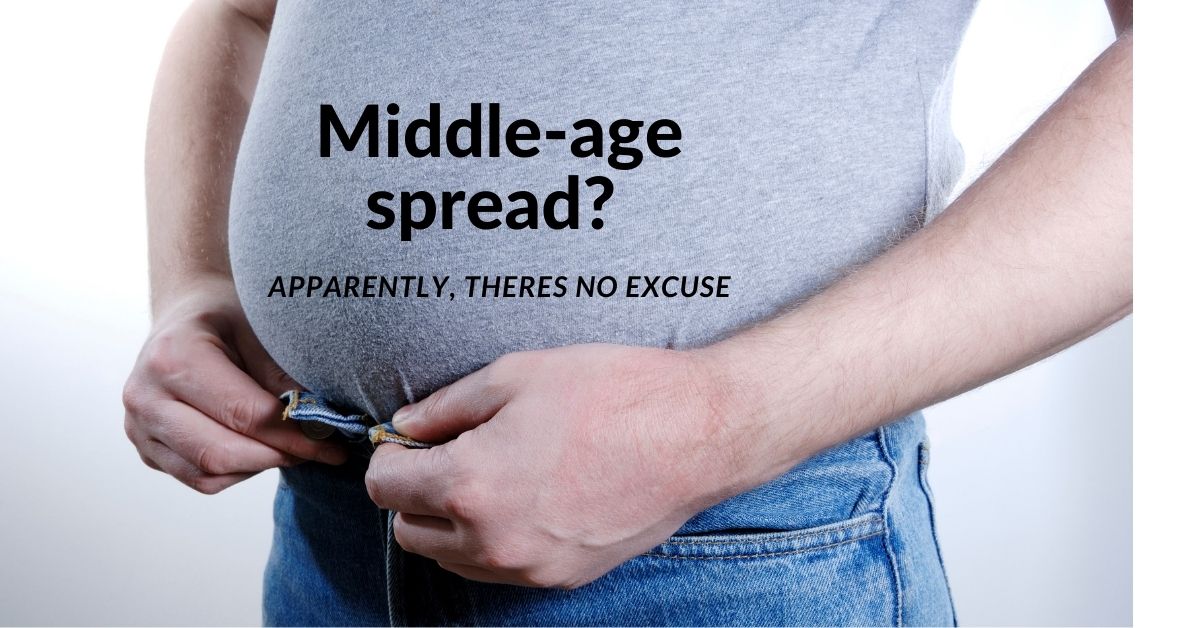
Hmmm…. This article piqued my interest the other day.
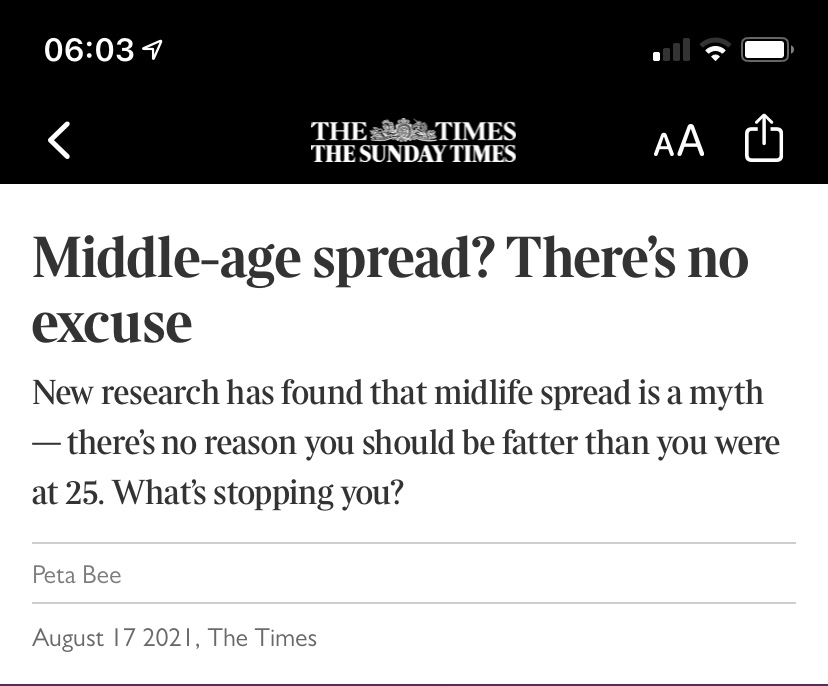
It’s a common belief that once you hit middle age your metabolism slows down. Shifting the pounds, or keeping them off, becomes harder. It turns out, scientists have proved otherwise!
In fact, a study of 6,500 people showed that the impact of metabolism didn’t present itself until the over 60’s. One of the authors summed it up as ‘further proof that ‘midlife spread is not a matter of biology but of behavior’. They went onto say that ‘ there is no biological reason why you should gain pounds as you age’
Why does this appear to happen though, you may be asking yourself? As an explanation, the same author suggests that, as we age, our gut may be better at digesting the foods that we eat. While we may be eating the same amounts of food, our guts are absorbing more of it. The spread may also be the result of changes in the hormones in our bodies. As we age, the mid-rift is the preferred dumping ground.
As we get older our lifestyles change, life gets in the way of working out. We have more disposable income to go out and eat indulgent foods and we perhaps become a bit less aware of it creeping up on us… next thing we know, we are looking in the mirror wondering what to do!
The article suggests a few ways of staving off the dreaded spread which are great tips:
Drink less alcohol
This is one for me. As I’ve got older alcohol tends to be more habitual. It’s not only the drink either. It’s the cake the crisps and general rubbish I’ll eat along with it (once I start I find it difficult to stop).
Drinking can be more regular, rather than only on weekends. It all adds up.
Maintain muscle mass
Muscle burns more calories than fat. As we get older we, unfortunately, start to lose muscle mass… it’s a thing. The longer we can delay this, the easier it will be.
Calorie control
I’ve changed the last suggestion from dieting to calorie control. I don’t agree with dieting. It contributes to yo-yo weight loss/gain. Some will result in weight gain once you stop.
Indeed, if you are overweight and you want to lose then you need to eat fewer calories. Weight loss and maintenance are easier if you are active, but it boils down to the food you eat. You can lose weight without exercising. You need to restrict the calorie intake… which is what most diets do. But, a diet suggests a temporary activity. Whereas, my approach is a lifestyle choice and one that is long-term. Most diets induce a short sharp drop in calories. When you come off the diet your body wants to eat more (check out my post on Why We Eat Too Much, a book on exactly that)
Obviously, I’m no scientist but it makes sense what they are saying. Hopefully, in 10 years’ time, I can prove that this is right!
If you have a subscription to The Times, here’s a link to the article if you fancy a read.
Alternatively, it can be found on Apple News